Free Wyoming Last Will and Testament Form
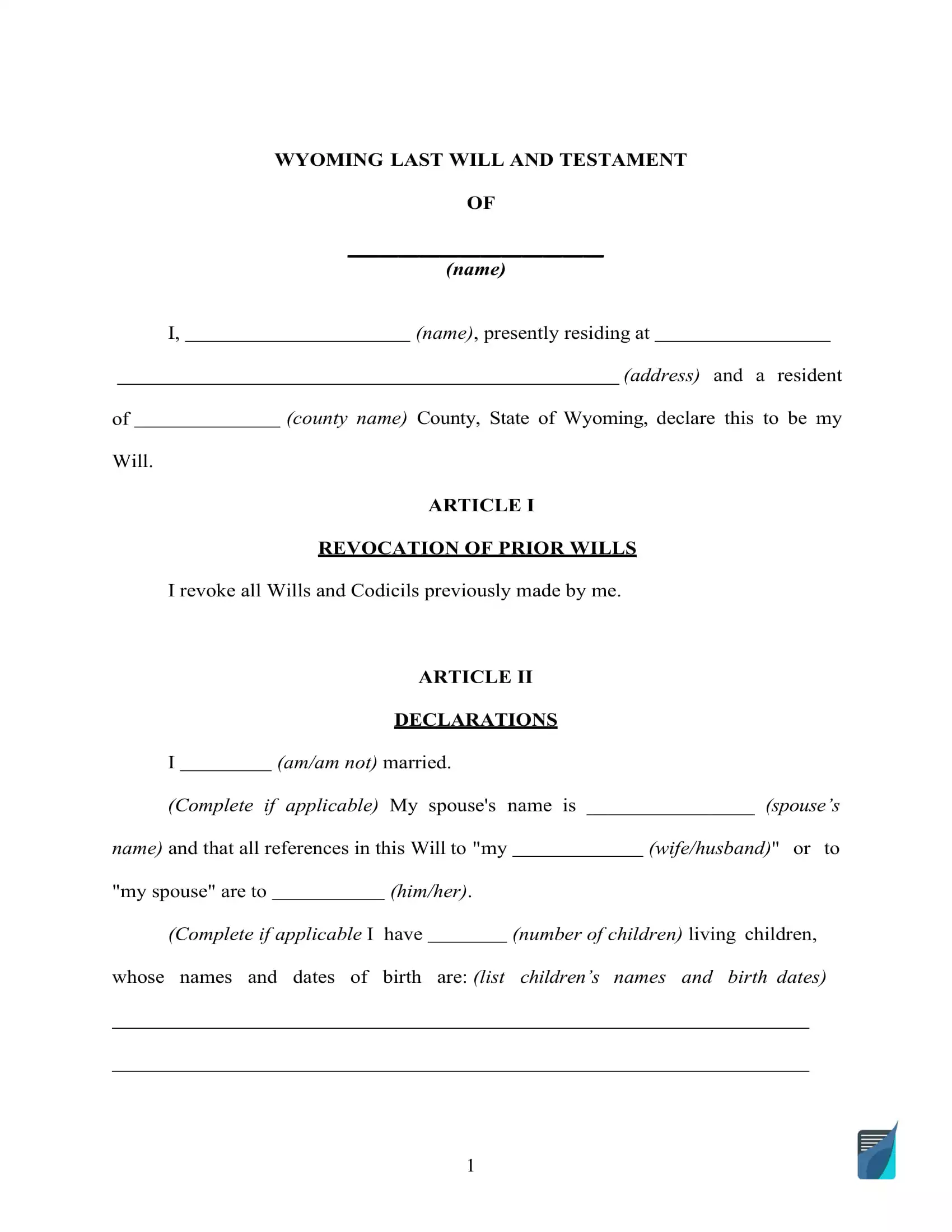
A Wyoming will is an important legal instrument that represents the final wishes of a testator with regard to their individual property and ways in which they’d want it to be distributed among chosen heirs.
Here, you will find a Wyoming will form available for download and the information that should eliminate your possible questions regarding property planning, types of will, and how to make a valid document in this state.
Build Your Document
Answer a few simple questions to make your document in minutes
Save and Print
Save progress and finish on any device, download and print anytime
Sign and Use
Your valid, lawyer-approved document is ready
Wyoming Last Will Laws and Requirements
| Requirements | State laws | |
| Statutes | Title 2 – Wills, Decedents’ Estates and Probate Code; Chapter 6 – Wills | |
| Signing requirement | Two witnesses | § 2-6-112. Will to be in writing; number and competency of witnesses; signature of testator; subscribing witness not to benefit; exception |
| Age of testator | 18 or older | § 2-6-101. Right to make and dispose; exception |
| Age of witnesses | 18 or older | § 2-6-115. Who may witness |
| Self-proving wills | Allowed | § 2-6-114. Self-proving wills |
| Handwritten wills | Recognized if meeting certain conditions | § 2-6-112. Will to be in writing; number and competency of witnesses; signature of testator; subscribing witness not to benefit; exception |
| Oral wills | Not recognized | |
| Holographic wills | Recognized if meeting certain conditions | § 2-6-113. Holographic will |
How to Make a Wyoming Last Will and Testament
1. Think about your possibilities. Before beginning, it’s best to decide if you would like to use the assistance of an attorney or create the whole document on your own. In case you want to create the last will by yourself, select the type you will go for: a handwritten will or maybe a free will forms.
2. Specify your details. Add your full name and address (the city, county, and state of residence) to ascertain the testator of the last will and testament. Go through the remaining portion of the passage, including the information you have entered along with the “Expenses and Taxes” subsection.

3. Choose the executor (or executrix). In this particular passage, you establish who is going to carry out your last will by filling out their full name, together with their city, county, and state of residence. Most states have specific rules regarding out-of-state agents and executors, which often implies more headache and red tape. Thus, it is advised to appoint someone who lives in the same state as you. Although not obligatory, it’s a wise decision to appoint one more person to perform the duty of your executor in the event the first one is unwilling or not capable of executing your last will and testament.

4. Appoint the guardian (optional). You are able to appoint a trusted person as a guardian in case you have underage or dependent children that must be taken care of. If there are no instructions pertaining to what person should look after your kids, the guardian will be appointed by the court.

5. Indicate your beneficiaries. This is where you indicate those who will receive your property. For each beneficiary, state the next particulars: full legal name, address, and the way they are related to you.
6. Allocate assets. List your property and explain the way in which you want to distribute it among your beneficiaries if you have something under consideration other than dividing the property evenly. Money for arrearage, realty, stocks, business control, cash, and any tangible items of financial value you possess can be mentioned in the last will. Please notice that there are things that can’t be distributed in the last will and testament, for instance, shared and living will assets and life insurance.

7. Ask witnesses to sign the document. Wyoming Statutes specify that a minimum of two witnesses must sign a last will for it to be regarded as valid. You are able to appoint somebody as a witness on the condition that they are over the age of 18 years and are uninvolved in the bequest. Think about picking witnesses who are younger than you to make sure that they will likely be around in the event the will is contested in court or if some other problem occurs. Now, you (as well as your two witnesses) must sign the document after filling out your full legal addresses and names. Be sure to look over each sentence thoroughly before concluding the matter.

Create a Free Wyoming Last Will

Other Wyoming Forms
Frequently Asked Questions
Is will notarization needed by Wyoming statute?
A will in Wyoming is valid without notarization. But in case you need to attach a self-proving affidavit to your last will, you will have to notarize it. If you make your last will self-proving, the court won’t have to speak to the witnesses to ascertain the legality of the document, which is going to expedite the probate.
Should I add a self-proving affidavit to my last will and testament in Wyoming?
It’s not necessarily in Wyoming. But, if you choose to include a self-proving affidavit, it’ll be quite helpful because the document serves as a substitute for in-court testimony of witnesses at the time of probate.
Can you leave out your children or spouse from a last will and testament?
In Wyoming, there’s no such concept as community or marital property. That means that the belongings collected or increased in the marriage do not have to be equally shared between the two spouses. Wyoming law allows you to exclude your marriage partner from your last will and testament completely. However, your spouse will be admitted to a determined minimum amount of your property.
Regarding the others, it’s legal in Wyoming to disinherit members of the family in the last will and testament. Your adult children or other relatives can be lawfully disinherited completely in your last will. To do that, include particular clauses to the last will.
In Wyoming, is it possible to alter a typewritten will after signing it?
Yes, it’s possible to modify it.
As outlined by Wyoming law, you can alter or repeal the last will and testament in case you are not obliged by a legal agreement that mentions otherwise.
Additionally, it will be a wise decision to review your will whenever you experience an important life event, such as:
- Birth or adoption of a child
- You have divorced or married
- Real estate or a considerable piece of property has been purchased or sold
- Great changes in your financial position
What if I lose my will?
In Wyoming, the law claims that the court can accept a last will if it’s damaged or lost. But, the probate court will not be likely to approve anything other than the original of the will to probate.
In line with Wyoming law, the will’s absence is assumed as its cancellation. This suggests that the executor will need to prove the last will’s validity, which in turn can be found to be very troublesome.
For a holographic will, you would need sworn witnesses and testimony to prove. That can make things more complicated. The reason behind not producing the will and its elements is to be proven as well.
In what way does a physically challenged individual sign their last will?
By Wyoming Estate Code, it will be possible for someone to sign his or her last will provided that it’s your (as a testator) directive and in your presence. The person who wrote the will can communicate his or her last wishes in words, through answering positively to an inquiry, or by body language.
A notary public can sign the name of the testator if the testator can’t do it due to a physical impairment. The notary has to be directed to perform it in the presence of a witness. Such a witness is decided on the same way someone would choose a trustee – they can’t have any legal or equitable interest in any property and assets being the issue matter of or affected by the last will.
Other Documents Related to Wills in Wyoming
| Related documents | Instances when you may need to make one |
| Codicil | You want to slightly modify your will without creating a new document from scratch. |
| Self-proving affidavit | You would like to steer clear of possible risks during the probate. |
| Living will | You want to express your wishes about the end-of-life medical treatment and life-prolonging procedures. |
| Living trust | You want to take care of your end-of-life affairs without probate. |
Last Will and Testament Forms for Other States
