Hawaii Minor Child Power of Attorney Form
The Hawaii minor child power of attorney form allows parents or legal guardians to grant authority to another adult to make decisions on behalf of their minor child. This legal tool is useful when parents or guardians cannot care for their child (temporarily) due to illness, military deployment, or extended travel.
Build Your Document
Answer a few simple questions to make your document in minutes
Save and Print
Save progress and finish on any device, download and print anytime
Sign and Use
Your valid, lawyer-approved document is ready
The legal basis for this arrangement in Hawaii is specified in Section 560:5-105 of the Hawaii Revised Statutes. This statute outlines the scope of decisions the designated attorney-in-fact can make, including everyday decisions about the child’s education, health care, and general welfare. Features of this power of attorney form include:
- Typically, the power of attorney is valid for a maximum of one year unless an earlier date is specified within the document.
- The power of attorney can be revoked at any time by the parent or guardian who granted it, provided they deliver written notice of revocation to the attorney-in-fact.
- The document must be signed by the parent or guardian in the presence of a notary public to ensure its legality and enforceability.
Parents considering this arrangement should carefully choose a trusted individual as the attorney-in-fact, as they will have significant responsibility for the child’s well-being. Check out all Hawaii POA forms if you need a specific power of attorney for health care or financial matters.
Hawaii Minor Child Power of Attorney Form Details
| Document Name | Hawaii Minor Child Power of Attorney Form |
| Other Name | Hawaii Temporary Guardianship Form |
| Relevant Laws | Hawaii Revised Statutes, Section 560:5-105 |
| Duration | One Year |
| Avg. Time to Fill Out | 10 minutes |
| # of Fillable Fields | 44 |
| Available Formats | Adobe PDF |
Filling Out Hawaii Minor Child POA Form
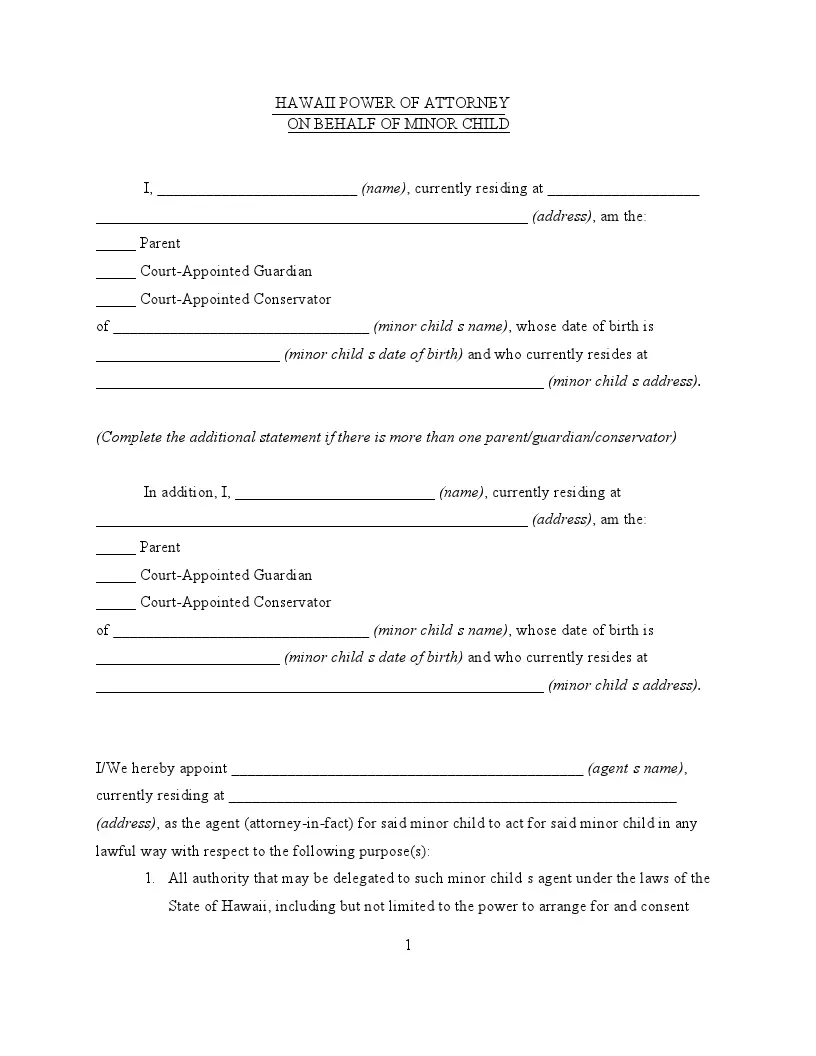
When preparing a Hawaii minor child power of attorney, it’s important to ensure that all sections of the form are filled out accurately to reflect your specific circumstances and intentions.
1. Identify the Principal
Start by identifying yourself as the principal. In the designated spaces, enter your full name and current residential address. Indicate whether you are the parent, court-appointed guardian, or court-appointed conservator of the minor child.
2. Provide Child’s Information
Next, you must provide the full name, date of birth, and current residential address of the minor child for whom you are establishing the POA.
3. Specify the Attorney-in-Fact
Identify the person you are appointing as the attorney-in-fact for your child. Include their full name and address. This person will make decisions for your child as specified in the POA.
4. Define the Scope of Authority
Decide whether the attorney-in-fact will have general authority or limited authority. If selecting general authority, no further specification is needed as it includes all powers allowable under Hawaii law. For limited authority, explicitly detail the specific powers and limitations you are granting.
5. Appoint a Successor Attorney-in-Fact
If you wish, you can appoint a successor attorney-in-fact who will take over if the initial attorney-in-fact cannot serve. Provide the name and address of the successor.
6. Specify the Effective Dates
Clearly state when the power of attorney will become effective and when it expires. Typically, the duration cannot exceed one year unless specifically extended.
7. Acknowledgment of Parental Rights
It is important to affirm that executing this power of attorney does not relinquish your parental rights over the minor child.
8. Sign the Document
Both you and the attorney-in-fact must sign the document in the presence of a notary public. Be sure to print your names below your signatures for clarity.
8. Notarization
Finally, the document must be notarized. This step confirms your identity and the voluntary nature of the signing. The notary public will fill out the remainder of the form, ensuring that all legal requirements for notarization are met.